PALECO IS THE CULPRIT BEHIND THIS COAL CONTROVERSY

Below is an article written by Mr. Joey Mirasol and posted originally at Bantay PALECO. It serves  as an exposition on the current power situation in Palawan. 


Due to much hecticity, have not posted much lately. But it’s nice to note that the No To Coal group has added Paleco to their gunsight, Paleco being the culprit behind the controversial coal plant that has divided our citizenry and raised doubts about the quality of our new provincial leaders.

The truth is now clear. The coal plant will not solve our electric power crisis. No additional power will be added to the existing 55MW of dependable generating capacity. DMCI has fulfilled their supply contract of 25MW using their diesel gensets, and the coal plant will only serve to increase DMCI’s profitability by allowing them to retire their less pollutive diesel gensets and shift to highly pollutive but less expensive coal. Need we help raise David Consunji’s ranking above being the #5 richest man in the Philippines?

Our power crisis is not caused by a lack of supply but by poor transmission and distribution facilities, problems not caused by the power producers but by Napocor and Paleco. The main order of business is to improve our transmission and distribution facilities, not to protect the power generators. Wasn’t it stupid on the part of Paleco to bid out power requirements way in excess of what we need? Our peak load as at October 2013 was 27MW, and even assuming a high demand in December of up to 30MW, we have an unused excess generating capacity of 25MW. Did Paleco ensure DMCI’s bid by requiring 25MW, when we could have done with 15MW through 2016? In doing so, Paleco disqualified renewable energy providers, who could only offer no more than 16MW within the 2 year time-frame given in the bid guidelines prepared by the consultant who is rumored to be allied with DMCI. Clear and simple bid rigging, don’t you think?

Our provincial leadership is obviously misinformed. Their desire to assure supply when needed may have led them to endorse the coal plant. But Paleco’s forecast demand will not consume the excess supply till beyond 2016. Paleco reports that as at September 2013, the status of electrification is 89% of 288 barangays province-wide. If by some miracle all were to be electrified today, we would need only an additional 3MW to supply the total requirements. But of course not all of the 31 barangays awaiting energization can be supplied without first running transmission and distribution lines, which should have been Paleco’s priority. PNoy’s ongoing sitio electrification program will also help increase the number of barangays electrified with off-grid systems for those that are in the islands or are very remote.

Our leaders are also under the impression that there are no serious renewable energy investors available, thus they may as well approve coal. Wrong again, because there is a serious hydro power provider that has been ignored by Paleco and a biomass power proponent (although this would again involve pollution because of wood-burning) waiting for a power supply agreement from Paleco. Due to the excess capacity, Paleco is not inclined to consider any other power supply provider, whether this be fossil fuel or renewable sources. Did Paleco create a coal monster that they are stuck with?

The solution to our power crisis is to improve the management of Paleco. We have a board made up of 3 overstaying directors, 1 past the qualified age, 2 who are mortal enemies, and the rest bystanders. Add to that an unqualified general manager, and you have a totally inept, self-serving and morally bankrupt management. Let us not forget that Paleco is our cooperative, it belongs to us members, and only we can do what is necessary to effect the much needed changes that will ensure a service-oriented, transparent, accountable and effective electric cooperative.

I have been waging a quixotic war against the GM and the board since September, to no avail. I have gone to the extent of filing a verified complaint with the NEA against the appointment of GM Sarra, who thick-facedly clings to her illegally-appointed position. I now need the help of the members to effect what needs to be done, which is to declare the positions of the entire board and general manager vacant.

Let us sign the No To Coal group’s petition to hold a general assembly, during which we should file a resolution to declare said positions vacant, and elect an interim board to serve for one year with the task of amending the cooperative’s by-laws and improving the service of Paleco, conditioned with the proviso that those elected to the interim board can no longer run as directors or apply for management positions in Paleco.

Are you all willing to do this for the good of our cooperative?

The Truth As Told By PALECO


There is no need for a coal-fired power plant in Palawan.


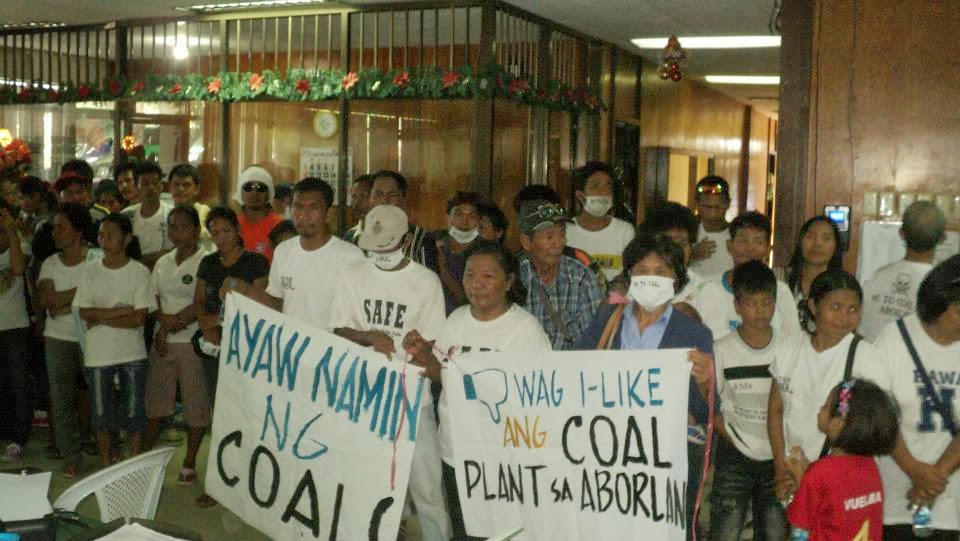
Right after the No To Coal Rally in Puerto Princesa City on November 28, 2013, the protesters proceeded to the Office of Palawan Electric Cooperative (PALECO). 


Here's a firsthand account of what transpired in PALECO as narrated by Mr. Tom Kutat, one of the Aborlan-based leaders of those opposed to the establishment of the coal-fired power plant:

"Wala ang PALECO General Manager, no'ng pumunta kami sa Paleco Office, buti at nakumbinsi namin ang naroong supervisor at spokeswoman na magpaliwanag. Hindi nila pweding sagutin ang issue sa legality ng PSA, Manager at Board lang ang may say doon. We asked the present status ng Paleco; sa weekly monitor nila, ilang makina ang under preventive maintenance, kaya 46MW lang ang total available power supply ng Paleco, mula sa tatlong supplyer, PPGI, DELTA P, at DMCI, ngunit ang Peak Load sa linggong ito ay 28MW lang, may 18MW na sobra. So bakit may BROWNOUT pa, ayon sa paliwanag nila, may problema pa sa SUBSTATION ng Narra, kayang-kaya supply-an ng Paleco Puerto ang kakulangan sa power supply ng Narra Substation, ngunit may problema sa Narra Substation and/or sa Transmission Line, hindi na sya nag-elaborate. Nagkakaroon ng Load Shedding sa Aborlan, Quezon at Inagawan dahil under preventive maintenance ang isang makina sa Narra Substation. Kung ayos lahat ng makina, ilan ang total generating capacity ng Paleco, 54MW daw. Question; Kung maitayo ang Coal Plant sa Aborlan, ilan na ang magiging total generating capacity ng Paleco? Parehas pa rin, 54MW pa rin, dahil ang PSA ng Paleco at DMCI ay 25MW lang, may 25MW Diesel Generators na ang DMCI sa Irawan, kaya na-comply na nila ang PSA. Gusto nila magtayo ng Coal Plant sa Aborlan para mixed ang kanilang supply sa Paleco, at bababa daw ng kaunti ang singil sa kuryente. With this mga kasama, makikita natin, na kahit hindi na magtayo ng Coal Plant sa Aborlan, na-comply na ng DMCI ang kanilang kontrata."

Let me translate this narration in English: 

The PALECO General Manager was not in her office when we arrived but it's good, we were able to convince the supervisor and spokeswoman to explain.

They cannot answer on the issue on the legality of PSA; it's only the Manager and the Board of Directors who are authorized to speak on the matter.

We asked about the present status of PALECO.

Based on their weekly monitor, some generators are under preventive maintenance and so the total available power supply from PALECO is only 46MW from the three suppliers, namely, PPGI, DELTA P, and DMCI. But the peak load this week is only 28MW, so there is an excess of 18MW.

So why are we still having brownouts?

According to their explanation, there is a problem with Narra Substation. PALECO Puerto Princesa City can very well supply the power deficiency in Narra Substation but there are problems with Narra Substation and/or transmission line. They did not elaborate further.

There was load shedding in Aborlan, Quezon, and Inagawan because one of the generators in Narra Substation is under preventive maintenance.

If all engines are working, what would be the total generating capacity of PALECO?

54 MW.

Question: If the coal plant in Aborlan will be constructed and becomes operational, what would be the total generating capacity of PALECO?

It would be the same, still 54 MW, because the PSA of PALECO and DMCI is only 25MW. DMCI  has an existing 25MW Diesel Generators in Irawan so they have already met the PSA. They want to construct a coal plant in Aborlan so they will have mixed supply to PALECO and thus lower the cost of electricity a little.

With this, my colleagues, we see that even without the coal plant in Aborlan, DMCI has already complied their contract with PALECO."

Watch this video courtesy of Ms. Marlene Jagmis for the actual explanation of the PALECO spokesperson:


So you see, there is no need for a coal-fired power plant in Palawan. The more that we must say NO TO COAL IN PALAWAN!


THE TRUTH BEHIND THE ENERGY SITUATION IN PALAWAN

1. Blackouts are caused by a lack of generating capacity – FALSE.

The majority of blackouts are caused by ground faults, equipment failures and lack of protection in the distribution system. Since January, 2013, the generating capacity on the Palawan mainland grid has increased from 40Mw to 54Mw. The number of blackouts, however, has actually increased significantly compared to the same period in 2012.Because of obsolescence and lack of capacity in the distribution grid, increasing demand from commercial and residential consumers is actually exacerbating the blackout problem. The distribution system must be modernized to provide redundancy and a sectionalized grid arrangement to avoid total system failure. Additional substations are required to provide magnetic isolation to protect the generation sector.

2. Palawan needs more power generation capacity – FALSE.

There are many views on the generation needs of Palawan. Future needs depend on demand growth with is directly related to GDP growth in Palawan. The national average demand growth for the Philippines is 4.4%. PALECO forecast a growth in demand for Palawan of between 12-18% per year and the contract with DMCI is based on this optimistic projection. Despite this possible over-contracting of generation capacity if developers can be found to invest their risk capital in putting up renewable energy facilities to be used as and when they can generate, each renewable kilowatt hour will save NPC and Philippines electricity consumers Php 6 and will save Palawan electricity consumers 12% VAT. Renewable energy development is without any risk to the consumers, or NPC whereas fossil fuel use is dependent on international market prices the risk of which is borne by NPC and Philippines consumers.

3. No serious proposals for renewable energy development in Palawan have been made – FALSE. 

This is a seriously misleading statement. Since 2007, proposals for hydro development under valid renewable energy service contracts with DoE have been made on at least 5 separate occasions to both PALECO and NPC. All proposals have been ignored. In order to finance development it is first necessary for proponents to have an electricity sales contract which has proved impossible to obtain despite considerably lower tariffs than fossil-fuelled options having been consistently offered.

4. There is a lack of investor interest in renewable energy development on Palawan – FALSE.

The Palawan Chamber of Commerce and Industry receives many inquiries from foreign and domestic firms and funding agencies inquiring about development opportunities for renewable energy on Palawan. There are currently three private firms, two of which hold renewable energy service contracts with government, which are active in the development and pre-development stages of installing solar, biomass and run-of-river hydro power plants on mainland Palawan. Work on the hydro plants has been ongoing continuously since 2007; despite this it has proved impossible for the developer to sell the power to be produced. The problem is not a lack of investor interest, but the existence of policy, political, and bureaucratic constraints and a lack of clear guidelines for development and implementation of renewable energy on Palawan and throughout the Philippines.

5. Renewable Energy is too expensive – FALSE.

In most cases, the initial capital or fixed cost of renewable technologies  is higher than conventional fossil-fuelled alternatives but this cost is borne by the developer and NOT the consumer or the UCME. Renewable technologies generally have much longer life cycles than fossil options and have no or very low fuel costs. Examples are run-of-river hydro, PV solar and wind power. At present, run-of-river hydro has a much lower TCGR than the proposed coal-diesel plant and requires no subsidy. It is expected that photo voltaic (PV) solar will soon reach grid-parity (equality) with coal-fired plants. In addition to lower generation rates, renewable energy requires little or no subsidy and consumers are exempt from payment of the 12% value-added tax (VAT). The net result of integrating renewables into the power mix is lower rates and reduced subsidy requirements. Both are good for the consumer and for the government.

6. Renewable Energy is Intermittent and inherently unreliable – FALSE.

All renewable energy is dependent on nature. Different technologies have different operational characteristics; wind and solar power vary directly in accordance with the weather. Hydro power varies only seasonally and in any event the plants proposed for Palawan have impounded water which can be used for top up power generation in dry periods. In addition, research by the International Energy Agency proves conclusively that renewable technologies are inherently more reliable and have only 10% of the breakdown time experienced by fossil fuel generation plants.

7. The subsidy to maintain low electric rates on Palawan is derived from the Malampaya Fund – FALSE.

Subsidies come from the Universal Charge for Missionary Electrification (UCME), a fund which derives revenue from every electric consumer in the Philippines and which is “topped up by NPC”. The level UCME is set by the regulator the Energy Regulatory Commission. The total consumer bill is divided in to three major components: the generation charge, the cost of distribution and the 12% value added tax. On Palawan, the generation charge is heavily subsidized. The real cost or True Cost Generation Rate (TCGR) is about P12.50 per kilowatt hour on the Palawan mainland grid. Consumers are charged only P6.5896 per kilowatt hour. The difference of about P6 per kilowatt hour represents the subsidy provided by the UCME. Consumers on the Palawan mainland grid used slightly more than 160 million kilowatt hours in 2012. The subsidy required to maintain the P6.6 generation rate was nearly one billion pesos. Adding in the subsidy required to maintain rates in off-grid municipalities or mini-grids brings the subsidy required to more than P1.3 billion/year.

8. PALECO’s activities are governed by DoE and ERC – FALSE.

PALECO’s activities are governed and overseen only by the General Manager and Board of Directors. The mandate of DoE is for national energy policy and planning only and that of the ERC to fix power rates. As PALECO are members of the Cooperative Development Association they are not yet under the supervision of the National Electrification Authority. Local government has no authority over the acts of PALECO – this is exemplified by the provincial council having issued three resolutions; two to PALECO and one to DoE/NPC to utilise available hydropower. Each request has been ignored.

9. Coal power will be converted to biomass/natural gas 3 years after start of operations – MISLEADING. 

While there are a few examples internationally of such fuel conversions these have been achieved with great technical difficulty and are only now in pilot operation modes. Fuelling 15MW of power with biomass requires 30+ tons/day/MW or 450 tons of wood per day. An earlier contract between PKReco and PALECO using biomass wood chip technology was cancelled due to the technical unfeasibility of this technology. The option of using natural gas (NG) seems logical, but is in fact, infeasible. The cost of pipeline transportation of natural gas from Malampaya to onshore Palawan is prohibitive given the size of the Palawan market. It was only just feasible to pipe the NG from Malampaya to Batangas to feed a power demand of 2,600MW. The Palawan market of about 40 MW is far too small to justify such an investment..

10. Electric Power Rates are higher on Palawan than in Manila – FALSE.

The subsidized rate Palawan consumers pay for electricity is nearly the same as the rate paid by MERALCO customers on the Luzon grid (see PALECO website). At present, the rate on Palawan is about P10 per kilowatt hour. However, adding in the P6 per kilowatt hour subsidy brings the true cost to nearly P16 per kilowatt hour.

11. Clean coal technology will be used by DMCI – FALSE.

“Clean” coal technology does not yet exist. There is no process available which can economically reduce carbon dioxide emissions from fossil fuelled power plants. Carbon dioxide emissions are the main cause of climate change, the results of which we are all experiencing recently in changing weather patterns. Technology does exist for removing or lessening some harmful emissions from coal fired power plants but it must be remembered that DMCI proposes to use coal from their Semirara mine which is a low quality “dirty coal” and thus has a low heating value [it is necessary to use more of it] and produces higher emissions than good quality coal.

12. DMCI will lower the cost of power to Palawan consumers – FALSE.

The cost of power generation to Palawan consumers will remain at the ERC set rate of Php 6.5896/kWh plus VAT. Only the use of unsubsidised renewable power can lower the cost of electricity to Palawan consumers as consumers do not pay VAT on renewable energy.

13. The Palawan power system is fully privatized – FALSE.

Despite claims by DoE that the Palawan power system was fully privatized in 2004/5 it is still heavily dependent on NPC who provide and operate 13 MW or 20% of the province’s diesel power. In addition, NPC owns and operates the 69Kv backbone transmission line. This fundamental misunderstanding causes tensions between NPC and PALECO to the detriment of an efficient power delivery service to Palawan consumers.

14. The power sales and purchase contract between DMCI and PALECO is fully effective –FALSE.

The Power Supply Agreement is not yet fully effective as no subsidy agreement has been signed between PALECO/NPC and DMCI. Additionally DMCI have failed to meet the contract requirements for the commercial operations date of their diesel plants and have even failed to meet an extended date granted to them by PALECO.

15. Hydro power developers were disqualified by PALECO from bidding in the2012 CSP – FALSE.

PALECO’s bidding terms required bidders to offer 25MW of guaranteed dependable capacity (GDC) – no renewable energy contribution was allowed as part of the specified 25 MW (GDC) as renewable energy was deemed “intermittent and not reliable”. The hydro developer did, however submit an “alternative bid” but this was again ignored by PALECO. 


(This article was originally posted in Puerto Princesa Watch [https://www.facebook.com/groups/175004469343174/] by Diana J. Limjoco on November 18, 2013)

THE BIOSPHERE RESERVE AND THE COAL PLANT

Since 1990, the entire island of Palawan has been declared a biosphere reserve by UNESCO.

"The Palawan Biosphere Reserve is a cluster of islands composed of one long main island and smaller groups of islands around it. The 1,150,800 hectares of the biosphere reserve include the entire Province of Palawan Island, which is the westernmost province of the Philippines." (see http://www.unesco.org/new/en/natural-sciences/environment/ecological-sciences/biosphere-reserves/asia-and-the-pacific/philippines/palawan/)


WHAT ARE THE CHARACTERISTICS OF A BIOSPHERE RESERVE?


The main characteristics of a biosphere reserve are:

  • Achieving the three interconnected functions: conservation, development and logistic support;
  • Outpacing traditional confined conservation zones, through appropriatezoning schemes combining core protected areas with zones where sustainable development is fostered by local dwellers and enterprises with often highly innovative and participative governance systems;
  • Focusing on a multi-stakeholder approach with particular emphasis on the involvement of local communities in management;
  • Fostering dialogue for conflict resolution of natural resource use;
  • Integrating cultural and biological diversity, especially the role of traditional knowledge in ecosystem management;
  • Demonstrating sound sustainable development practices and policies based on research and monitoring;
  • Acting as sites of excellence for education and training;
  • Participating in the World Network.
(http://www.unesco.org/new/en/natural-sciences/environment/ecological-sciences/biosphere-reserves/main-characteristics/)


WHAT IS A BIOSPHERE RESERVE IN PRACTICE?


Biosphere reserves harmonize conservation of biological and cultural diversity, and economic and social development, through partnerships between people and nature. They also contribute to the transition to green societies by experimenting with green development options such as sustainable tourism and training for eco-jobs.


IS THE INTRODUCTION OF A COAL FIRED POWER PLANT IN PALAWAN CONSISTENT WITH THE BIOSPHERE RESERVE?


Absolutely NO. The approval of the coal plant is inconsistent with the nature of Palawan as a biosphere reserve. It is not in harmony with conservation of biological and cultural diversity since coal fired power plants are known to be damaging to human health, to biodiversity, and to the natural physical environment. In effect, it has negative impact on the economic and social development of a biosphere reserve. The use of coal, the dirtiest fuel source known, does not promote the greening of societies nor promote green development options since it is destructive to the natural environment.


WHAT WILL HAPPEN IF A COAL PLANT IS CONSTRUCTED IN PALAWAN?


It is inevitable that the distinction as a biosphere reserve will be withdrawn from Palawan, without which, its sustainable development will be sacrificed.


WHAT NEEDS TO BE DONE?


It is important that sustainable development of Palawan must be pursued. We demand that the approval of the coal fired power plant project of PALECO and DMCI be scrapped the soonest possible time. Coal plants are being dismantled around the world. There is no such thing as "clean coal" so this project must be junked.

We propose that the provincial government of Palawan pursue renewable energy sources in unity with the world's effort to control  global pollution. We can be the leader and model in renewable energy. It only takes a working conscience, a heart for Palawan, common sense, and righteous political will.


THE PALECO-DMCI-PALAWAN GOVERNMENT CONSPIRACY

Is there really a conspiracy? Let's see.

1. Semirara is owned by the 5th richest man in the Philippines, David Consunji of DMCI (http://www.rappler.com/business/21968-one-of-ph-s-richest-own-semirara)

2. Semirara Mining Corporation mines coal in Caluya, Antique. It has experienced significant loses and  expects earnings to recover in the second half of the year on the strength of its power generation business, offsetting the weakness of its coal mining operations. (http://www.interaksyon.com/business/72438/as-coal-business-sags-semirara-looks-to-power-to-boost-profit). Take note, DMCI is losing money thus it enters power generation business.

3. DMCI was contracted by Palawan Electric Cooperative to construct a 15-MW coal fired power plant in Narra, Palawan but it was met with protests so they relocated the project to San Juan in Aborlan, Palawan (http://newsinfo.inquirer.net/488875/palawan-coal-plant-meets-protests-anew). 

(PALECO alleges that there is a need for additional power to address the incessant brownouts. However, PALECO's report of October 2013 says that power is sufficient. See http://coalisbusted.blogspot.com/2013/11/paleco-october-2013-report-shows-power.html)

4. Barangay officials of San Juan went to La Paz, Iloilo and conducted an ocular inspection/interview of people who claimed that the coal plant poses no risk to the environment. Their claim runs counter to what was reported in Panay News (http://www.panaynewsphilippines.com/component/content/article/7662-empty-promises.html).

5. Despite the strong opposition of the people of Aborlan as expressed in a series of public consultations and barangay assemblies, the Sangguniang Bayan (Legislative Body) approved a resolution endorsing the project to the Sangguniang Panlalawigan. They timed it when the Kagawads who are opposed to the project went out during a brief recess of the session. The Municipal Mayor of Aborlan approved the endorsement without second thoughts for he sees no reason to disapprove a project which he perceives to be pro-development. He explained that if ever he vetoes the resolution, the Kagawads will endorse it anyway so why delay the process? (http://coalisbusted.blogspot.com/2013/11/mayor-jaime-ortega-of-aborlan-palawan.html)

6. Before October ended, when virtually every Palaweno was busy cleaning the tombs of their dead, the Sangguniang Panlalawigan held a special session to approve the 15-MW coal-fired power plant. The news was aired in a local radio station and it caught many by surprise. (https://www.facebook.com/Dzip864RadyoPalaweno/posts/459402880843889).

7. On November 4, 2013, the people of Aborlan staged an indignation rally to express their anger towards the action of the Sangguniang Bayan, perceived to be traitors to the people who elected them to office. You see, Aborlan residents did not waiver in expressing their opposition to the project(https://www.facebook.com/media/set/?set=a.181453665383840.1073741829.178264855702721&type=3).

8. Vice Governor Dennis Socrates calls the decision to approve the coal-fired power plant as "political will" and that the Sangguniang Panlalawigan decided "in favor of development" (http://coalisbusted.blogspot.com/2013/11/vice-governor-of-palawans-remarks-on.html)

9. Governor Alvarez was consistent in his support of the project from the start as he verbalized during DMCI's education campaigns in a local university, in providing trucks to haul alleged YES TO COAL supporters from other communities, and as he expressed during a radio interview where he belittled the number of Aborlan residents who oppose the coal plant. He has claimed repeatedly that the coal plant is safe, contrary to the information found in reputable sources cited by environmentalists and scientists. 

PEOPLE, IT IS HOW THIS COAL-FIRED POWER PLANT WAS SHOVED DOWN THE THROAT OF EVERY PALAWENO.

THEY SCRAMBLED TO APPROVE THE PROJECT DESPITE THE FACT THAT PALECO HAS SUFFICIENT POWER! ARE THOSE BROWNOUTS DONE ON PURPOSE TO SET THE STAGE FOR THIS BIG DRAMA?

THEY PUSHED THROUGH WITH IT WHEN EVERYONE KNOWS THAT COAL IS THE DIRTIEST FUEL AND HIGHEST CONTRIBUTOR OF GREENHOUSE GASES! DESPITE THE FACT THAT COAL PLANTS ARE BEING CLOSED IN SOME OTHER PARTS OF THE WORLD! DESPITE THE DAMAGES THAT COAL PLANTS CAN DO TO THE ENVIRONMENT! 

NOW, CONNECT THE DOTS AND DECIDE WHETHER THERE IS INDEED A CONSPIRACY.